

What is a GCC in India?
A Global Capability Centre (GCC) — also called a Global In-house Centre (GIC) or Captive Centre — is a wholly-owned subsidiary established in India by a multinational corporation to deliver specialised, high-value services exclusively for its parent company. Unlike traditional outsourcing, a GCC gives the parent full ownership, direct IP control, and a dedicated talent pipeline.
For AI companies, an AI GCC in India serves as a strategic offshore hub for machine learning model development, data engineering, AI product R&D, cloud infrastructure, and back-office operations — at 60–75% lower cost than equivalent operations in the US, Europe, or Japan.
Why Do AI Companies Choose India to Set Up a GCC?
India offers the largest AI/ML talent pool in the world, costs that run 60–75% lower than the US or Europe, 100% FDI under the automatic route, and a government that actively courts GCC investment through tax holidays and state-level incentives. No other country combines all four at this scale.
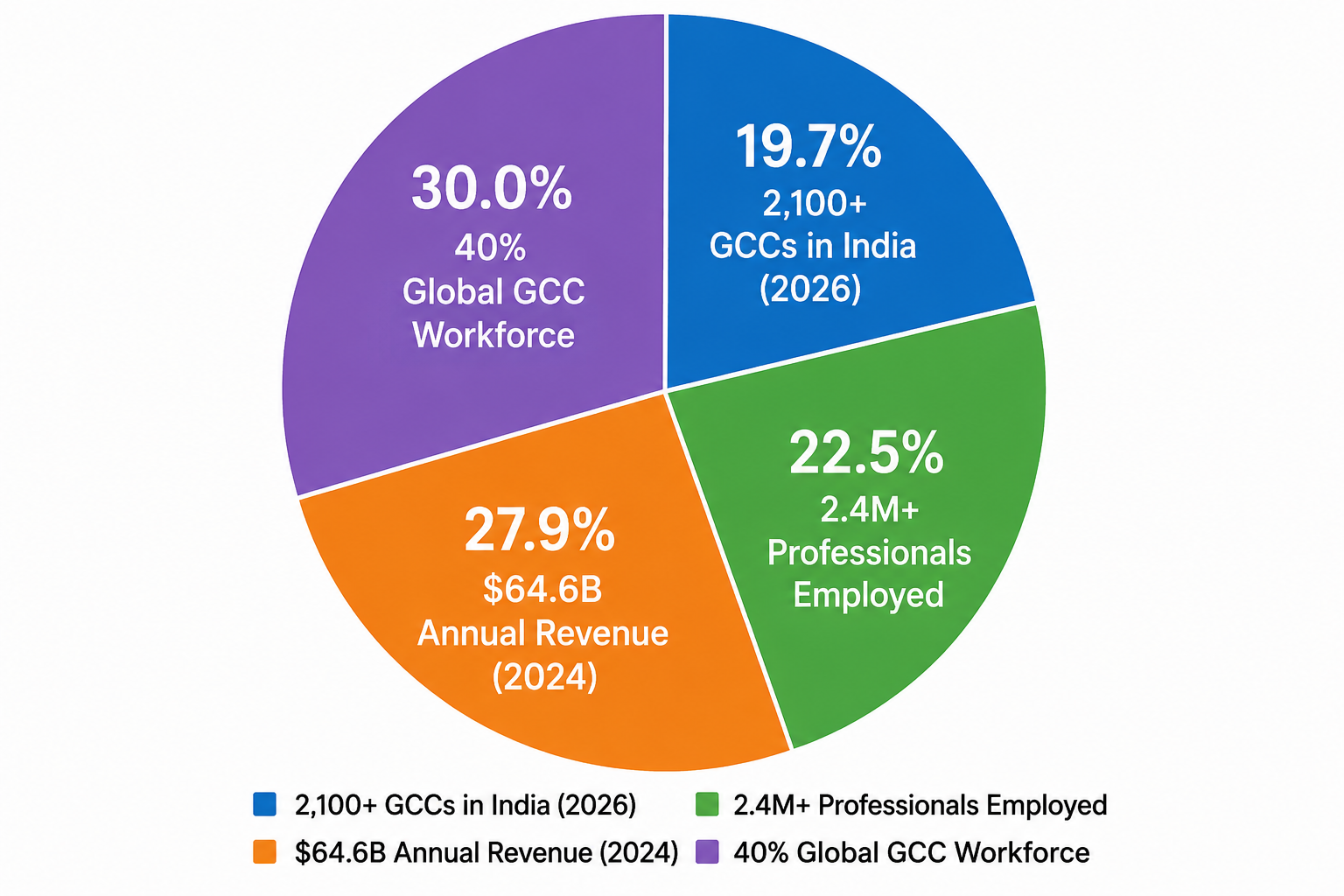
Vast AI Talent Pool
India produces over 2.3 million STEM graduates annually and is home to 500,000+ active AI/ML professionals — the largest such talent pool in the world. GCCs in India now employ approximately 2.4 million people, with AI-centric roles growing at 12–14% CAGR. Reskilling initiatives grew to 71% across GCCs in 2025 (EY GCC Pulse Survey), and over 185 dedicated AI/ML Centres of Excellence are already operational across Indian GCCs as of early 2026.
Cost Efficiency
Engineering and operations costs in India are 60–75% lower than in the US or Europe, covering both salaries and real estate:
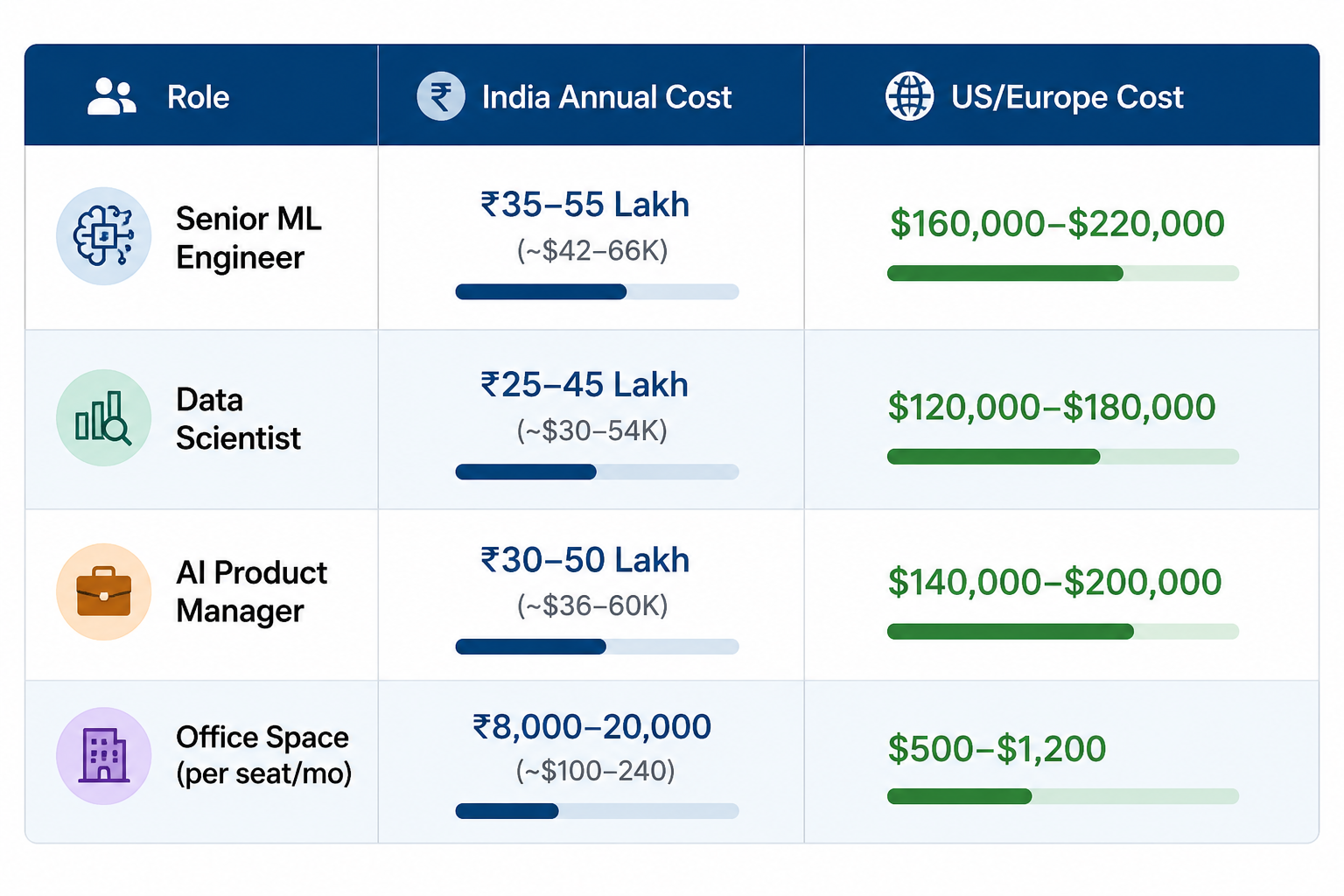
Tier-II cities such as Ahmedabad, Coimbatore, and Jaipur offer a further 15–25% cost reduction over Bengaluru and Hyderabad, making them increasingly attractive for AI back-office and annotation functions.
Hybrid & Remote Model — Cost-Smart Scaling
Indian company law permits fully hybrid or remote-first GCC operations, requiring only a registered address. This enables AI companies to:
- Start lean — virtual/co-working office during incorporation phase, zero upfront real-estate capex
- Hire top AI talent across multiple cities without geographic restriction
- Scale headcount dynamically, transitioning to dedicated space only when operationally justified
- Reduce initial setup cost by 40–60% compared to a fully fitted leased facility
| 🏢 Phased Office Strategy for AI GCC |
| Phase 1 (0–20 staff): Virtual registered address + co-working seats — Bengaluru / Hyderabad / NCR |
| Phase 2 (20–100 staff): Managed plug-and-play GCC facility with IT infrastructure included |
| Phase 3 (100+ staff): Dedicated Grade-A leased office with branding, AI labs, and collaboration spaces |
R&D for New AI Tools & Products
Indian GCCs now handle 45% expertise and frontier work — closer to HQ-level decisions than any other offshore location (Zinnov, 2026). India’s ecosystem uniquely supports AI R&D through IIT/IISc research partnerships, a vibrant open-source developer community, and IST time zone overlap enabling near-24-hour development cycles with US/EU teams. The Union Budget 2026-27 also introduced a cloud and data centre tax holiday until 2047, directly benefiting AI-intensive GCC operations.
Government Policy Support
- 100% FDI under automatic route — no prior government approval required for IT/AI sector
- Safe Harbour threshold raised from ₹300 crore to ₹2,000 crore — reducing transfer pricing disputes
- Cloud tax holiday until 2047 — directly benefits AI compute-heavy GCCs
- State-level GCC incentive policies in Karnataka, Telangana, Tamil Nadu, Gujarat, and Andhra Pradesh
Which Global AI Brands Have Set Up GCCs in India?
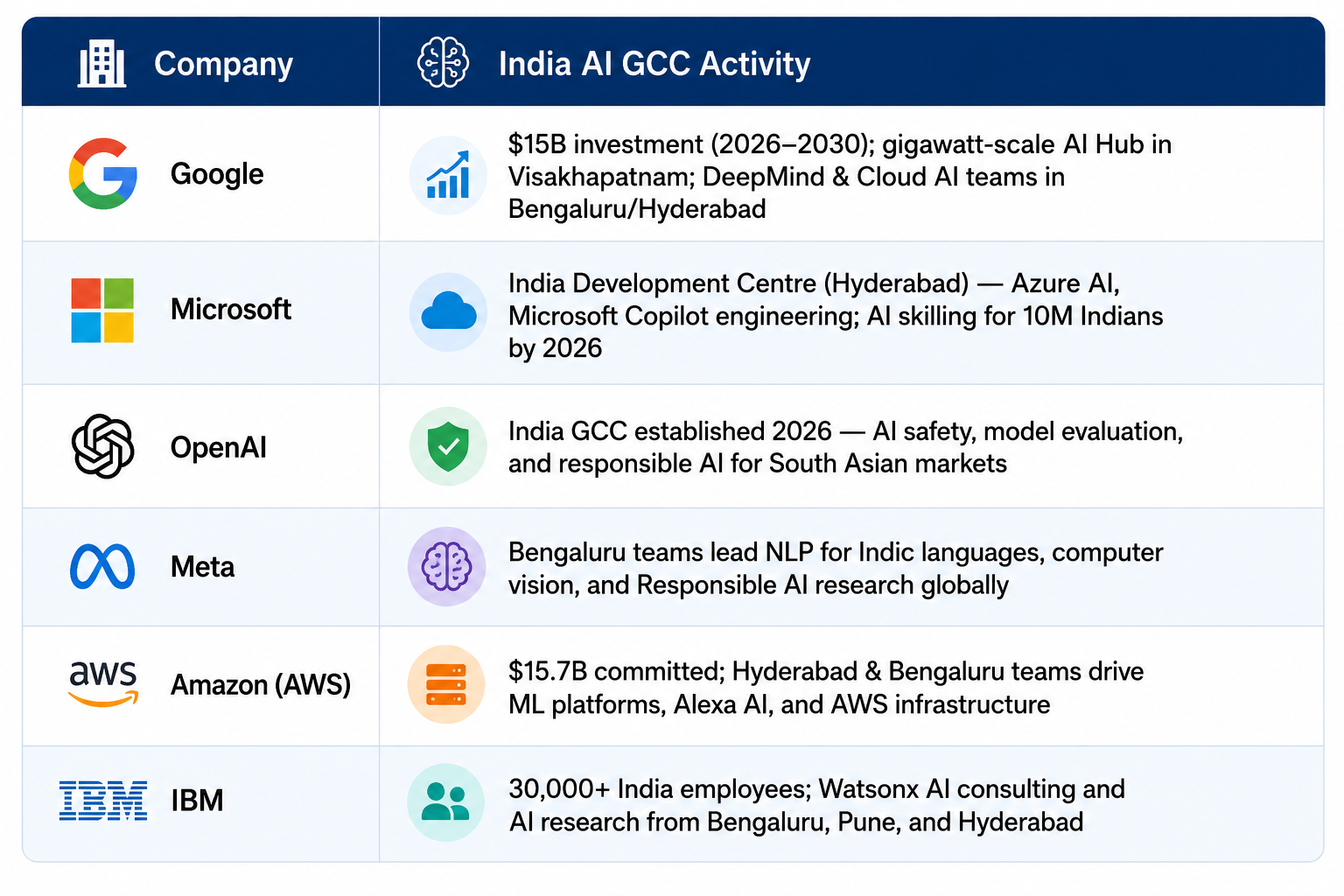
Google, Microsoft, OpenAI, Meta, Amazon, and IBM are among the biggest names operating AI GCCs in India. These are not back-office setups, they run frontier AI research, model evaluation, and product engineering from India, with combined investment commitments running into tens of billions of dollars.
The world’s leading AI and technology companies have committed billions to India — not merely as a delivery location, but as a strategic AI co-creation hub.
58% of AI GCCs in India are currently investing in Agentic AI, with an additional 29% planning to do so within 12 months — the highest AI adoption rate among GCC destinations globally (EY GCC Pulse Survey, 2025).
What Are the Core Legal Requirements to Register an AI GCC in India?
To register an AI GCC in India, you need a minimum of 2 directors (at least one Indian resident), 2 shareholders, and a registered office address anywhere in India. Co-working spaces are fully accepted. The foreign parent can hold 99.99% of shares, making it a 100% wholly-owned subsidiary under Indian law.
Establishing a Private Limited Company (wholly-owned subsidiary) in India requires three foundational elements:
| Requirement | Details |
| Minimum 2 Directors | At least one must be an Indian resident (182+ days/year in India). Can be Indian citizen or foreign national residing in India. A professional nominee resident director can be appointed during setup. |
| Minimum 2 Shareholders | Can be individuals, body corporates, or both. Foreign parent typically holds 99.99% shares as body corporate; 0.001% held by an individual nominee — establishing a 100% wholly-owned subsidiary. |
| Registered Office Address | Any valid address in India for regulatory correspondence. Co-working spaces and business centres fully accepted. Must be confirmed within 30 days of incorporation. |
How Do You Set Up an AI GCC in India Step by Step?
The entire process of setting up an AI GCC in India runs through the MCA portal and takes 5 to 10 working days for legal incorporation. No physical presence in India is required at any stage. The 7 steps cover name reservation, incorporation filing, certificate issuance, registered office confirmation, bank account opening, capital infusion with RBI compliance, and filing Form 20A to commence operations.
| ⚡ 7-Step GCC Setup Process |
| Step 1 — Name Reservation (Day 1–3): File SPICe+ Part A on MCA portal. Foreign companies can suffix ‘India’ to preserve global brand identity. Approval in 1–3 business days. |
| Step 2 — Incorporation Application (Day 2–6): File SPICe+ Part B with MoA, AoA, director consents. Simultaneous PAN, TAN, EPFO, ESIC registrations generated. |
| Step 3 — Certificate of Incorporation (Day 4–8): Registrar of Companies (RoC) issues CoI confirming legal existence, CIN, PAN, and TAN. |
| Step 4 — Registered Office (Day 8–15): Submit lease deed / NOC / utility bill / office photographs to RoCwithin 30 days of incorporation. |
| Step 5 — Bank Account Opening (Day 5–12): Open current account with Indian or international bank. Typically5–7 working days with complete documents. |
| Step 6 — Capital Infusion & RBI Compliance (Day 10–30): Foreign parent remits share capital (min. ₹1,00,000 recommended). File FC-GPR on FIRMS portal within 30 days of share allotment. |
| Step 7 — Commencement of Business — Form 20A (Day 30+): File Form 20A confirming capital receipt. Company can legally commence operations only after this filing. |
| Total: 5–10 working days for legal incorporation | 3–6 months for fully operational GCC |
What Post-Incorporation Compliance Does an AI GCC in India Need to Follow?
Once incorporated, mandatory compliance includes GST registration, professional tax, Shop & Establishment registration, annual RoC filings, FLA Return to RBI by 15 July, Transfer Pricing documentation (Form 3CEB) for all intercompany transactions, and income tax return filing by 31 October every year.
Once incorporated and capital compliance is completed, the following registrations and annual filings are mandatory for AI GCC in India:
| Compliance | Key Requirement |
| GST Registration | Mandatory within 30 days of commencing revenue-generating services |
| Professional Tax | State-level registration required within 30 days of first hire |
| Shop & Establishment | Municipal registration required for all commercial establishments |
| Import Export Code (IEC) | Required for cross-border IT/AI service exports — issued by DGFT |
| Annual RoC Filings (AOC-4 / MGT-7) | Filed within 60–90 days of financial year-end — mandatory every year |
| Annual FLA Return (RBI) | Foreign Liabilities and Assets return — due by 15 July each year |
| Transfer Pricing — Form 3CEB | Mandatory for ALL transactions with foreign parent company; annual TP documentation required |
| Income Tax Return | Filed by 31 October for entities with transfer pricing obligations |
Ready to Set Up Your AI GCC in India?
To setup your AI GCC in India, CorporateLegit provides end-to-end GCC setup support, from incorporation and RBI/FEMA compliance to talent structuring and ongoing post-incorporation advisory. We have helped multiple foreign companies establish and scale their AI GCC operations in India successfully.
Frequently Asked Questions (FAQs)
Q1: How long does it take to set up an AI GCC in India?
Legal incorporation is completed in 5–10 working days. A fully operational GCC — with team, infrastructure, and compliance in place — typically takes 3–6 months depending on scale.
Q2: Can a foreign AI company own 100% of its India GCC?
Yes. The IT and software sector is under the 100% FDI automatic route — no Indian partner or government approval is needed. Full ownership and IP control are retained by the foreign parent.
Q3: What is the minimum investment required?
There is no statutory minimum capital under the Companies Act. Banks typically require ₹1,00,000 (~USD 1,200) to open a current account. Total setup costs including professional fees and initial compliance range from ₹2–5 lakh (~$2,500–6,000).
Q4: Which Indian city is best for an AI GCC?
Bengaluru leads for deep AI/ML talent and product engineering. Hyderabad offers strong analytics talent and a pro-business environment at lower cost. NCR (Gurugram/Noida) is ideal for enterprise AI and fintech. Tier-II cities like Ahmedabad and Coimbatore provide 15–25% further cost savings for annotation, QA, and junior engineering roles.
Q5: What are the tax obligations for a foreign-owned AI GCC?
The Indian subsidiary is taxed as a domestic company at an effective corporate tax rate of ~25.17% (22% base + surcharge + cess). Transfer pricing regulations require arm’s length pricing for all intercompany transactions, with mandatory annual documentation and Form 3CEB filing. The expanded safe harbour regime (up to ₹2,000 crore threshold) simplifies compliance for qualifying IT/ITeS GCCs.