

How to Set Up an Auto Component Manufacturing Company in India: The Complete Delhi NCR (National Capital Region) Investment Guide for Foreign Companies
A practical, data-backed roadmap covering the industrial cluster, land acquisition, company registration, licences, government incentives, and a real foreign investor success story — everything you need to begin auto component manufacturing in India.
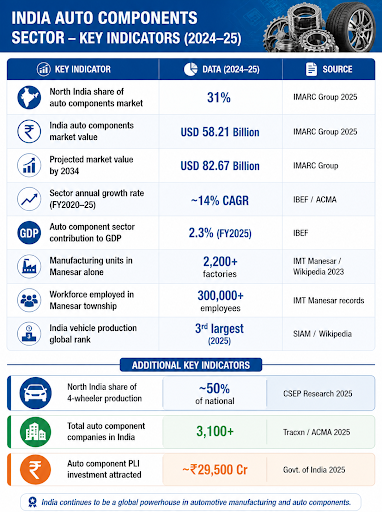
Delhi NCR — India’s largest auto component manufacturing cluster, contributing 31% of the national market (IMARC Group, 2025)
Why Foreign Companies Choose India — and Delhi NCR — for Auto Component Manufacturing?
Auto component manufacturing in India has emerged as one of the most compelling investment opportunities for global automotive suppliers. With India ranked the world’s third-largest vehicle producer in 2025 and the national auto components market reaching USD 58.21 billion, the question for foreign companies is no longer whether to consider India — it is where within India to set up a factory. For any company evaluating automotive parts manufacturing investment, or exploring how to open a manufacturing company in India, this guide provides the definitive answer.
Within India, one cluster consistently leads: the Delhi NCR belt spanning Gurugram, Manesar, Noida, Greater Noida, and the Yamuna Expressway corridor. This region accounts for 31% of India’s total auto components output, hosts 2,200+ manufacturing units in Manesar alone, and serves as the primary supply base for Maruti Suzuki, Honda Motorcycles, and Hero MotoCorp. The following sections cover everything a foreign investor needs to know — from cluster data and land costs to company registration steps and the licences required before your machines can run.
Delhi NCR Auto Component Cluster: Factory Numbers & Market Data
The Delhi NCR auto component cluster is India’s most mature and densely networked manufacturing belt, with a presence across Haryana (Gurugram, Manesar, Kharkhoda, Faridabad) and Uttar Pradesh (Noida, Greater Noida, YEIDA (Yamuna Expressway Industrial Area) belt. The sector contributed 2.3% to India’s GDP in FY2025, employed 1.5 million people nationally, and grew at roughly 14% CAGR between FY2020 and FY2025 (IBEF/ACMA).
The northern cluster runs primarily along NH-48 from Gurugram and Manesar in Haryana through Bhiwadi and Bawal in Rajasthan. The UP corridor — Noida, Greater Noida, and the YEIDA belt toward the upcoming Jewar International Airport — is expanding rapidly, especially for electronics-intensive auto components and EV sub-assemblies.
What Are the Five Core Advantages of the Delhi NCR Location for Auto Component Manufacturing in India?
For auto component manufacturing in India, Delhi NCR offers 300,000 industrial workers in a single township with ITI and polytechnic graduates available within commute distance. HSIIDC industrial estates deliver dedicated HT and LT power supply with 100% backup capability. Just-in-time delivery to Maruti Suzuki’s Manesar plant is achievable within 30 to 90 minutes, eliminating warehousing costs. Four government authorities — HSIIDC, GNIDA, YEIDA, and UPSIDC — actively allot industrial plots on 90-year leasehold basis. IGI Airport sits 32 km from Manesar with the upcoming Jewar International Airport adding a second air freight hub for the UP corridor.
A. Skilled Manpower — 300,000+ Industrial Workers in One Township
The NCR has one of India’s deepest pools of manufacturing-ready engineers and technicians. Industrial Training Institutes (ITIs) and polytechnics across Haryana and Uttar Pradesh produce tens of thousands of diploma-level graduates annually. Research from CSEP (2025) confirms that around 80% of auto component firms in the NCR cluster access both skilled and semi-skilled labour within commute distance. Manesar alone employs 300,000 workers across its 2,200+ manufacturing units.
B. Reliable Power Infrastructure
HSIIDC industrial estates in Haryana deliver dedicated power supply with both HT and LT industrial connections via DHBVN/UHBVN discoms. The UP side is served by PVVNL and DVVNL. Most operational units in Manesar and Greater Noida maintain 100% power backup through captive DG sets or third-party open-access power arrangements — critical for precision manufacturing processes including CNC machining, die casting, and surface treatment.
C. Cost-Competitive Operations
Labour costs in Delhi NCR, while higher than inland UP or Rajasthan, are offset by dramatic logistics savings. Just-in-time delivery to Maruti Suzuki’s Manesar plant is achievable within 30–90 minutes from most IMT Manesar supplier lo acations, eliminating warehousing and freight costs. Industrial power tariffs in Haryana (approximately ₹7–9 per unit for HT industrial consumers) are competitive within North India. Land entry at emerging IMT Kharkhoda (HSIIDC reserve price ~₹39,200/sqm) is significantly cheaper than comparable zones in Pune or Chennai.
D. Industrial Land from Four Government Authorities
Four development authorities actively allot industrial plots across the NCR belt: HSIIDC (Haryana), GNIDA (Greater Noida), YEIDA (Yamuna Expressway), and UPSIDC (Uttar Pradesh). Allotment rates range from ₹22,800/sqm at IMT Sohna to ₹68,800/sqm at IMT Manesar Phase-V (HSIIDC 2025–26 e-auction). All plots are on 90-year leasehold basis — fully bankable for project finance and term loans from Indian and foreign banks.
E. Unmatched Logistics & Export Connectivity
The NCR benefits from NH-48, the KMP (Kundli–Manesar–Palwal) Expressway, the Eastern Peripheral Expressway, the Yamuna Expressway, and both the Eastern and Western Dedicated Freight Corridors. IGI Airport sits just 32 km from Manesar, enabling rapid air freight of precision and high-value components. The upcoming Noida International Airport at Jewar will add a second major air freight hub for the UP side — critical for export-oriented manufacturers supplying global OEMs.
What Government Incentive Schemes Are Available for Auto Component Manufacturing in India in 2025?
The Central PLI Scheme attracted approximately ₹29,500 crore in investment and created 45,000 jobs by 2025. Haryana’s HEEP 2020 provides Net SGST reimbursement, electricity duty exemption, stamp duty refund, and interest subsidy on term loans. The Make in Haryana Industrial Policy 2025 adds an employment subsidy of ₹48,000 per employee per year for 10 years. Uttar Pradesh offers capital subsidy and SGST reimbursement through its Investment and Employment Promotion Policy via the Invest UP single-window portal.
Foreign and domestic investors setting up an auto component manufacturing company in India can access a layered set of central and state incentives:
| Scheme | Authority | Key Benefit |
| PLI(Production Linked Scheme) Scheme — Automotive & Auto Components | Govt. of India (MHI) | Incentives on incremental sales; ~₹29,500 Cr investment attracted, ~45,000 jobs created by 2025 |
| Haryana Enterprises & Employment Policy (HEEP) 2020 | Govt. of Haryana | Net SGST reimbursement, electricity duty exemption, stamp duty refund, interest subsidy on term loans |
| PADMA — MSME Advancement Programme | Haryana MSME Directorate | Mini industrial parks in 143 blocks; plug-and-play sheds; ₹170 Cr cluster infra; shared testing centres |
| Make in Haryana Industrial Policy 2025 | Govt. of Haryana | Capital subsidy, EV incentives, employment subsidy ₹48,000/employee/year for 10 years |
| UP Investment & Employment Promotion Policy | Govt. of Uttar Pradesh | Capital subsidy, SGST reimbursement, single-window via Nivesh Mitra; EV-specific YEIDA incentives |
| 100% Stamp Duty Reimbursement | Haryana (B/C/D blocks) | Full stamp duty refunded within 5 years of commencement of commercial production |
| MSME Interest Subsidy | Haryana MSME Directorate | Interest subsidy on term loans for new manufacturing units (2021–2025 scheme window) |
FDI Policy Note for Foreign Companies The auto components sector operates under India’s Automatic FDI Route — 100% foreign ownership is permitted with NO prior government approval required. A foreign company incorporates an Indian Wholly Owned Subsidiary (WOS) as a Private Limited Company under the Companies Act 2013, reports the FDI inflow to the Reserve Bank of India under FEMA within 30 days of receiving funds, and proceeds. No FIPB approval, no sectoral cap, no mandatory joint venture. This is among the most investor-friendly FDI sectors in India. |
The factory setup journey: from site selection to commercial production typically takes 20–30 months in Delhi NCR
What Does the DENSO Corporation’s Success Story Reveal About Auto Component Manufacturing in India?
DENSO Corporation’s India journey: from a single Manesar plant to a regional manufacturing and global R&D ecosystem
DENSO entered via OEM-proximate Tier-1 manufacturing at IMT Manesar supplying Maruti Suzuki directly. It expanded to Greater Noida for the Honda Motorcycles ecosystem, formed a JV with Uno Minda for faster OEM access, and elevated to Regional HQ and 7th Global R&D Centre within two decades. The four-stage playbook — OEM-proximate entry, UP-side expansion, local JV formation, and regional headquarters elevation — is directly replicable for any foreign auto component company entering India today.
Few companies illustrate the logic of choosing Delhi NCR for auto component manufacturing better than DENSO Corporation of Japan — the world’s second-largest automotive parts supplier. DENSO’s India strategy is a textbook example of how to set up a factory in India as a foreign company and scale it progressively.
Step 1 — OEM-proximate entry via IMT Manesar: DENSO Haryana Pvt. Ltd. was India’s first 100% foreign-owned auto component manufacturing subsidiary (100% owned by DENSO Corp., Japan), established at IMT Manesar, Gurugram. The location was deliberate — direct proximity to Maruti Suzuki enabled just-in-time supply of fuel pumps, injectors, engine ECUs, and ISCV units from Day 1.
Step 2 — UP-side expansion to Greater Noida: As volumes grew and Honda Motorcycles became a key customer, DENSO India Pvt. Ltd. was established in Greater Noida, UP, manufacturing alternators, starters, and magnetos. This gave DENSO active coverage on both sides of the NCR — Haryana for the Maruti ecosystem and UP for the Honda ecosystem.
Step 3 — Joint venture with Indian partner Uno Minda: In 2012, DENSO Ten Minda India Pvt.Ltd was formed as a JV with Uno Minda (NK Minda Group, headquartered in Manesar), manufacturing car infotainment systems. The partnership provided DENSO instant access to Uno Minda’s established OEM relationships and nationwide distribution.
Step 4 — Elevation to Regional HQ and Global R&D Centre: Today, DENSO operates its India Regional Headquarters from Manesar, which also houses its 7th Global R&D Centre and 9th Global Technical Training Centre. A single Tier-1 plant became a multi-entity, multi-state manufacturing and innovation ecosystem within two decades.
Key Takeaway for Foreign Investors DENSO’s four-stage NCR playbook — (1) Enter via OEM-proximate Tier-1 manufacturing in Manesar; (2) Expand to the UP side as customer base grows; (3) Form a JV with a local partner for faster OEM access; (4) Elevate to Regional HQ + Global R&D Centre — is directly replicable for any foreign auto component company entering India today. The same OEM base, the same industrial infrastructure, and the same government incentive frameworks remain available. The principal difference is that early-mover advantage now sits in emerging zones like IMT Kharkhoda rather than in the already-saturated Phase I–IV of IMT Manesar. |
What Is the Step-by-Step Process to Open an Auto Component Manufacturing Company in India?
Phase one covers site selection and land acquisition through HSIIDC or GNIDA portals with e-auction participation and lease deed execution within 60 days of allotment, taking 3 to 9 months. Phase two covers Private Limited Company incorporation through SPICe+ with apostilled documents, resident director, PAN, TAN, and RBI FDI reporting within 30 days, taking 2 to 4 weeks. Phase three covers concurrent licence applications including GST, Factory Licence, Pollution Board consents, EPF, ESIC, and IEC, taking 1 to 4 months. Phase four covers factory construction and commissioning, taking 12 to 24 months before commercial production begins.
Phase 1: Site Selection & Land Acquisition — 3 to 9 months
Select your state — Haryana (HSIIDC) or Uttar Pradesh (GNIDA / YEIDA / UPSIDC) — based on OEM proximity, product type, and land budget. Prepare a Detailed Project Report (DPR) in the authority’s prescribed format. Apply via the relevant portal (HSIIDC at hsiidc.bidx.in; GNIDA at greaternoidaauthority.in; YEIDA at yamunaexpresswayauthority.com), deposit the Earnest Money Deposit, and participate in the e-auction (HSIIDC) or the Screening Committee interview (YEIDA). On receiving the allotment letter, execute the lease deed within 60 days and take physical possession within 15 days of the lease deed.
Phase 2: Company Registration — 2 to 4 weeks
Incorporate a Private Limited Company through MCA’s SPICe+ portal. For foreign companies the requirements include: apostilled and notarised Memorandum and Articles of Association, Digital Signature Certificates for all directors, and at least one resident Indian director. PAN and TAN are issued simultaneously. Report the FDI inflow to the Reserve Bank of India under FEMA within 30 days of receiving funds from the foreign parent.
Phase 3: Licences & Registrations — run concurrently, 1 to 4 months
| Licence / Registration | Issuing Authority | Approx. Timeline |
| MSME Udyam Registration | Ministry of MSME (online, self-declaration) | 1 day |
| GST Registration | GSTN Portal | 3–7 working days |
| Factory Licence (Factories Act 1948) | State Labour Dept / Inspector of Factories | 30–60 days |
| Consent to Establish — Pollution Board | UP PCB / Haryana SPCB | 30–90 days (green category faster) |
| Consent to Operate — Pollution Board | UP PCB / Haryana SPCB | After building completion |
| EPF Registration | EPFO Regional Office | 3–7 working days |
| ESIC Registration | Employee State Insurance Corporation | 3–7 working days |
| Trade Licence / Municipal NOC | Local Urban Local Body (ULB) | 15–30 days |
| IEM (Industrial Entrepreneur Memo) | DPIIT (online) | Acknowledged within days |
| Import-Export Code (IEC) | DGFT | 2–3 working days |
| BIS Certification (if applicable) | Bureau of Indian Standards | 60–90 days |
Phase 4: Factory Construction & Commissioning — 12 to 24 months
Obtain building plan approval from the development authority. Steel pre-engineered building (PEB) construction for a 2,000–5,000 sqm factory typically takes 6–12 months. Install plant and machinery, conduct trial runs, obtain the Completion Certificate from the authority, then apply for the Consent to Operate from the State Pollution Control Board. The factory must become fully functional within 48 months of the lease deed date under HSIIDC and YEIDA terms.
What Is the End-to-End Timeline for Setting Up an Auto Component Factory in India?
Pre-setup and DPR preparation takes 1 to 2 months. Land acquisition takes 3 to 9 months. Company registration takes 2 to 4 weeks. Core licences run concurrently and take 2 to 4 weeks. Pollution and factory NOC takes 1 to 3 months. Construction takes 12 to 18 months. Commissioning takes 2 to 3 months. Commercial production typically begins between months 20 and 30. Concurrent filing of licences during land acquisition can save 2 to 3 months from the overall timeline.
| Phase | Key Activities | Duration |
| Pre-setup | DPR preparation, site visits, authority portal registration | 1–2 months |
| Land Acquisition | Application, e-auction / committee interview, allotment, lease deed | 3–9 months |
| Company Registration | SPICe+ incorporation, PAN/TAN, bank account, FDI reporting to RBI | 2–4 weeks |
| Core Licences | GST, Udyam, EPF, ESIC, IEC — run concurrently with land acquisition | 2–4 weeks |
| Pollution & Factory NOC | Consent to Establish, Factory Licence — run concurrently | 1–3 months |
| Construction | Building plan approval, civil and structural work, fit-out | 12–18 months |
| Commissioning | Trial production, Consent to Operate, final inspections | 2–3 months |
| Commercial Production | First shipment to OEM customers | Month 20–30 |
Practical Tip Engage a local industrial consultant familiar with your chosen authority (HSIIDC or GNIDA) from Day 1. Use the state single-window portals — Nivesh Mitra for UP and Invest Haryana for Haryana — to track all approval statuses in one place. Concurrent filing of licences in Phase 3 and land acquisition in Phase 1–2 can save 2–3 months from the overall timeline. |
Conclusion — Why Delhi NCR Is the Best Location for Auto Component Manufacturing in India
For any foreign company evaluating where to establish an auto component manufacturing unit in India, Delhi NCR delivers a case no other Indian region can match. The region holds 31% of the national auto components market, hosts OEMs generating over 50% of India’s four-wheeler production, employs 300,000+ industrial workers in a single township, and connects to any North Indian OEM within hours via an expressway network second to none in the country.
The cluster is not standing still. Maruti Suzuki’s 900-acre Kharkhoda mega plant, the Noida International Airport at Jewar, the active Dedicated Freight Corridors on both the Haryana and UP sides, and the EV component supply chains building out along the YEIDA corridor are all creating fresh investment windows — particularly for foreign companies that move early into emerging zones like IMT Kharkhoda before land prices converge with established Manesar rates.
Government incentives — the Central PLI scheme, Haryana’s HEEP 2020 and employment subsidy of ₹48,000 per worker per year for 10 years, and UP’s capital subsidy and SGST reimbursement — substantially de-risk the greenfield investment decision. DENSO, Bosch, Honda, Napino Auto, Munjal Showa, and hundreds of smaller global Tier-1 and Tier-2 suppliers have already validated the thesis with operating plants. The ecosystem is proven, the infrastructure is in place, and the OEMs are expanding. For any foreign company considering automotive parts manufacturing investment in India, Delhi NCR is the address. Connect with our team at CorporateLegit today and let us guide you for auto component manufacturing in India.
FAQ — Auto Component Manufacturing in India for Foreign Companies
Q: Can a foreign company own 100% of an auto component factory in India? A: Yes. The auto components sector is under India’s Automatic FDI Route, meaning 100% foreign equity is permitted with no prior government approval needed. A foreign company incorporates an Indian Private Limited Company (wholly owned subsidiary) under the Companies Act 2013 and reports the FDI inflow to the Reserve Bank of India under FEMA within 30 days. No joint venture is mandatory, though JVs with Indian partners are common for faster OEM access and distribution reach. |
Q: How long does it take to set up an auto component manufacturing company in India? A: The end-to-end timeline from site selection to commercial production typically runs 20–30 months in Delhi NCR. This covers 3–9 months for industrial plot allotment from HSIIDC or GNIDA, 2–4 weeks for company incorporation via MCA’s SPICe+ portal, 1–3 months for concurrent licences (factory licence, pollution NOC, GST, EPF, ESIC), and 12–18 months for factory construction and commissioning. Using the Nivesh Mitra (UP) or Invest Haryana single-window portals from Day 1 can reduce the timeline by 2–3 months. |
Q: Which is better for auto component manufacturing — Noida (UP) or Manesar (Haryana)? A: Both are strong but suit different investor profiles. Manesar (HSIIDC) is best for Tier-1 suppliers to Maruti Suzuki and Honda — OEM proximity enables just-in-time delivery and the existing supplier ecosystem is the deepest in North India. Noida and Greater Noida (GNIDA/UPSIDC) offer slightly lower land costs and access to the Honda Motorcycles and electronics supply chain. For EV components and export-oriented units, the YEIDA belt toward Jewar Airport offers the lowest land costs and strongest government incentives from UP. |
Q: What licences does a Japanese or foreign company need to manufacture auto parts in India? A: Key licences include: Factory Licence under the Factories Act 1948; GST Registration; MSME Udyam Registration (for MSMEs); Consent to Establish and Consent to Operate from the State Pollution Control Board; EPF and ESIC registrations; Import-Export Code (IEC) from DGFT; and BIS Certification for any component under mandatory BIS standards. For a foreign-incorporated parent, additionally: FDI reporting to RBI under FEMA, and apostilled incorporation documents for the Indian subsidiary. |
Q: What government incentives are available for auto component manufacturing in India in 2025? A: At the central level: the PLI Scheme for auto components offers incentives on incremental sales — it attracted ~₹29,500 crore in investment by early 2025. At the state level, Haryana’s HEEP 2020 provides Net SGST reimbursement, electricity duty exemption, stamp duty refund, and interest subsidy on term loans. The Make in Haryana Industrial Policy 2025 adds an employment subsidy of ₹48,000 per employee per year for 10 years. Uttar Pradesh offers capital subsidy and SGST reimbursement through its Investment & Employment Promotion Policy via the Invest UP single-window. |
Q: What is the minimum investment to set up an auto component factory in Delhi NCR? A: For a small Tier-2/Tier-3 precision component unit (300–500 sqm plot at GNIDA or UPSIDC rates), the minimum viable all-in investment is approximately ₹3–8 crore covering land premium, basic factory shed, and starter machinery. For a mid-size Tier-1 supplier unit (2,000 sqm plot in IMT Kharkhoda or Greater Noida), a realistic total project cost runs ₹15–30 crore. For a Tier-1 unit at IMT Manesar Phase-V (2,000 sqm at ₹68,800/sqm), land alone is ~₹14 crore before building and machinery. Foreign companies should additionally budget 8–12% for regulatory, legal, and liaison costs during the setup phase. |
Q: What auto components are most in demand for manufacturing in Delhi NCR? A: Engine parts lead India’s auto components market with a 28% share (IMARC Group 2025), covering pistons, crankshafts, cylinder heads, and valve train components. Wiring harnesses, transmission systems, braking systems, suspension components, and electronic control modules are all actively sourced by Maruti Suzuki, Honda Motorcycles, and Hero MotoCorp from the NCR cluster. EV-specific components — battery management systems, motor controllers, lightweight structural assemblies, and onboard chargers — are the fastest-growing segment, driven by India’s national EV push and YEIDA’s dedicated EV industrial zones. |
Sources & References
IMARC Group — India Automotive Components Market Report 2025 | IBEF / ACMA — Auto Component Industry Data FY2025 | CSEP — Automation in India’s Automotive Sector, April 2025 | DENSO India — Corporate Profile (denso.com/in) | HSIIDC — IMT Manesar Profile & E-Auction Notifications 2025–26 (hsiidc.org.in) | Make in Haryana Industrial Policy 2025 (investharyana.in) | Invest UP — Auto Components Sector (invest.up.gov.in) | Wikipedia — Manesar (2023 industrial data) | Tracxn — Auto Components India 2025 | MCA (Ministry of Corporate Affairs) — SPICe+ Incorporation Process | GSTN | EPFO | Bureau of Indian Standards